Certificate of Good Standing
What you get: sample document
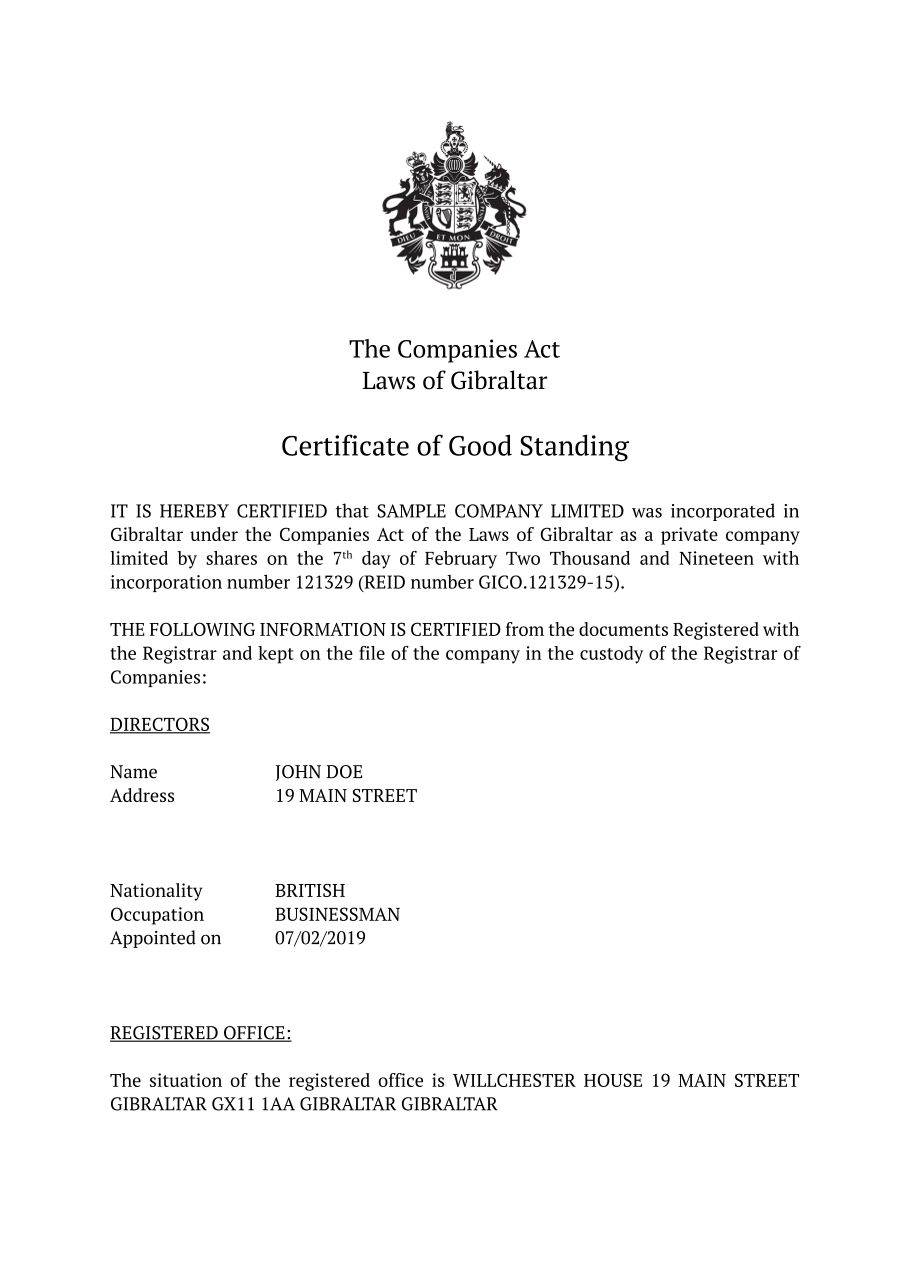
The sample is a Gibraltar Registrar Certificate of Good Standing for a private company limited by shares. It certifies incorporation date and number, a director’s name, address, nationality and appointment, and the registered office from documents on the company file. 1 page in the sample document.
- JurisdictionGibraltar
- FormatPrinted document, sent by courier
- DeliveryUp to 2 business days
- ✓Official document issued by the registry
Certificate of Good Standing for a Gibraltar Company
A Certificate of Good Standing (CoGS) is, in practical terms, Gibraltar Companies House’s confirmation that a company is still active on the register and has kept up with the statutory filings required under the Companies Act 2014.
The important part is the filing record. Companies House Gibraltar, acting through the Registrar of Companies, will only issue the certificate where the company is fully up to date with the filings it is required to make.
As at September 2026, the latest Companies House guidance I have identified is Guidance Note 7, updated in August 2025, read alongside the current Companies Act and the applicable 2025 fee regulations.
What appears on a Gibraltar Certificate of Good Standing
The Gibraltar certificate contains rather more information than the equivalent document in many other jurisdictions.
According to Companies House, it records Registry information current as at the date the certificate is issued. That includes the company's name and incorporation or registration number, the names and addresses of its current directors and secretary, its registered office, its share capital, and any charges registered against it at Companies House Gibraltar.
It also confirms that, according to the Registry's records, the company is not in the course of dissolution, liquidation or striking off.
There is a further version of the certificate which includes shareholder information. That version works differently. It can only be requested by an officer of the company, who must complete the List of Shareholders or List of Members forming part of the CoGS application. Companies House makes clear that the shareholder information shown on the certificate is based on the list submitted and confirmed as part of that application.
That makes the Gibraltar CoGS a slightly unusual document. It is not merely a bare statement that the company remains in good standing; in practice, it can also perform some of the role that a certificate of incumbency or detailed company-registry extract performs elsewhere.
What “good standing” actually means
This is the point worth keeping firmly in mind.
In Gibraltar, “good standing” is principally about compliance with the company's statutory filing obligations under the Companies Act 2014. It should not be read as a wider seal of approval covering the company's finances, commercial reputation, profitability, tax position, regulatory compliance or absence of disputes.
Companies House gives a number of fairly ordinary reasons why a company may not qualify for a CoGS. Its annual returns or accounts may be overdue. Changes involving directors or secretaries may not have been filed correctly. Share allotments or transfers may be missing from the Registry record. Sometimes the problem is simply that information already filed is inaccurate and needs to be corrected.
Accounts are especially significant. Under current Companies House guidance, an ordinary private company will generally have 12 months from the end of the relevant financial year in which to file its accounts, while a public company will generally have 10 months. What must actually be filed depends on the company's size. Micro and small companies will normally have lighter requirements, often involving an abridged balance sheet, whereas larger companies face more extensive reporting obligations.
Annual returns form the other obvious part of the picture. Companies are expected to keep core information—such as their registered office, directors, secretary and shareholders—properly updated and to file the relevant annual return.
So “good standing” is meaningful, but it is meaningful within a defined statutory context. It is easy to read too much into the phrase.
What the certificate does — and does not — establish
The distinctions are easier to see in practical terms:
| Question | What the Gibraltar CoGS establishes |
|---|---|
| Does the company legally exist and remain registered? | Yes, in substance. |
| Are its Companies Act filings up to date? | Yes. This is at the heart of good standing. |
| Is it being dissolved, liquidated or struck off according to Registry records? | The certificate addresses this. |
| Who are its current registered officers? | Yes, according to the Registry record. |
| What is its registered office and share capital? | Yes. |
| Are charges registered against the company? | Yes, to the extent they are registered at Companies House Gibraltar. |
| Is the company solvent? | No. |
| Can it pay all debts as they fall due? | No. |
| Is it free from litigation or disputes? | No. |
| Has it paid all Gibraltar taxes? | The CoGS does not establish this. |
| Is it licensed or authorised by the Gibraltar Financial Services Commission? | Not merely because a CoGS has been issued. |
| Is it compliant with AML or KYC obligations? | No. |
| Does it have no undisclosed liabilities? | No. |
| Does it own all the assets it claims to own? | No. |
There is a simple reason for those limitations. Companies House describes the certificate by reference to Companies Act filing compliance. It is not conducting an audit of the company's financial position, tax affairs, regulatory status or commercial liabilities before issuing the document.
That distinction matters, particularly in due diligence. A clean CoGS can be useful evidence, but it should not be mistaken for something broader than it is.
The insolvency wording goes a little further
One part of the application deserves separate mention.
Where the version containing shareholder information is requested, the company officer who signs the application makes a number of additional confirmations. Among other things, the officer confirms that no striking-off request has been made, that the company is not subject to a voluntary winding-up or winding-up petition, that no receiver or manager has been appointed in the circumstances identified on the form, and that no insolvency proceedings under the Insolvency Act 2014 have begun.
That adds useful information. Still, I would not describe the resulting document as a solvency certificate.
The distinction may sound technical, but it is important. A company can be unable to meet its debts even though no formal insolvency procedure has yet started. Absence of insolvency proceedings and actual solvency are not the same thing.
Who may request a Certificate of Good Standing?
For the standard certificate, the answer is straightforward: anyone may apply.
A person seeking evidence that a Gibraltar company remains active and compliant can request the standard CoGS using Form CoGS 1. There is no general requirement for the applicant to be a director, secretary or shareholder of the company.
The position changes where shareholder information is to be included. Companies House requires that version to be requested by an officer of the company, who must also complete the relevant shareholder or member details.
The application itself is reasonably detailed. Among other matters, it asks for the company's name and number, its authorised and issued share capital, its registered office, and the details of its current directors and secretary.
When Companies House will not issue one
Not every Gibraltar registration qualifies.
Companies House states that Certificates of Good Standing are not issued for companies registered under Part XII or Part XIV of the Companies Act 2014. Broadly speaking, those parts concern particular categories of overseas or foreign company registration, including branch-type registrations, rather than the usual Gibraltar-incorporated company.
There is a further restriction on the long-form certificate. Companies House states that it will not issue a CoGS containing shareholder information for a public limited company.